Debbie Gruber

Debbie Gruber, Creator of EasyPianoStyles.com

I’m Gonna Teach You a Lesson!
The Best Piano Lesson You’ve Ever Had. Jump Start Your Musical Engine and Zoom into Playing Piano, the Fun Way (with Lots of Musical Shortcuts)

Free Music Newsletter called eNotes, Delivered To Your Computer Door
Every 2 weeks by Signing Up

You will receive:
Mini-Lessons – Many in Audio Form!
Tips and Techniques for Singing and Playing Piano
Interviews with Experts from Professors and Broadway Performers
Early-Bird Offers for Classes, Workshops and Books

AND a Special Bonus:

Free Report, “The 12 Secrets to Effective Practicing”

Send me my Free Report now.

Email:
Name:
Then


Don't worry -- your e-mail address is totally secure.
I promise to use it only to send you eNotes.

P.S. After signing up, you will gain INSTANT ACCESS (by download) to the first two chapters of The Piano EXPRESS, a beginner method for learning chords so you can play any music you like from a fake book!


Enter Our Website

The Piano EXPRESS


"Debbie Gruber's 'The Piano Express' is a valuable addition to the literature of piano pedagogy because it appeals to different learning styles. Students learn the keyboard, treble clef notation, and helpful shapes and diagrams of black and white key patterns add a tactile element. Also, the method imparts basic music theory and chord hierarchic knowledge, a facet that many piano instruction methods lack."

-- Mark Shilansky, Jazz Pianist, Assistant Professor at Berklee College of Music, Lecturer in Jazz at University of New Hampshire and University of Southern Maine


Here are some valuable lessons you will learn from this program:

** Surprisingly simple method for learning all 12 Major Chords. This will help you immeasurably in memorizing your chords based on visual patterns rather than note-reading.


**How to finally be able to read from a fake book - We will de-mystify the process and show you just what those symbols mean


**Learn how to accompany yourself singing! This is a pretty simple process based on solid musical concepts that you have learned in the book. Learn techniques for accompanying a slow ballad and an up-tempo tune.


**Learn three great formulas for constructing major, minor, and seventh chords.


**Stop buying sheet music for $3.95 a song. Develop your own arrangements. It's a much more creative approach to playing the piano! You design how you want to play a song. This program shows you how.


**Learn how to transpose any song into your key. Many people don't realize how easy this is to do and how much of a difference it can make when you are playing with others.


**Learn a very easy trick for figuring out what "key" you are playing in. Then learn the predictable chords that will go with that key. This accelerates the learning process ten-fold.


**Tricks for reading a melody line with your right hand, even if you don't know all of the notes yet. Focus on the intervals (you'll learn what those are) and what that means to your right hand piano playing.


**No more the bass clef! Everything is melody line and chord. Takes the pressure off all of that tedious note-reading.


So now for the cost of less than one 1/2 hour piano lesson, you will get 6 months worth of lessons that will take you from where you are now to sitting down at your piano or keyboard and playing the music you love to play.

It's worth the $25 investment.

Try The Piano Express RISK-FREE for 90 Days. This is our guarantee to you. You can easily get a refund if you are not 100% satisfied!


Want to Create Your Own Arrangments? Take a Look.

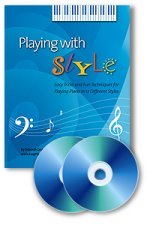
Playing With Style


Listen to Easy Stride demonstration


Listen to technique for playing a ballad


Testimonial from student


Testimonial from student


Testimonial from Ron of Carmel, Indiana

"Playing with Style" was written for the student who knows their chords pretty well and doesn't know what to do with them. Sure, you can play the chords with the left hand and the melody with the right hand, but this gets boring after a while. This special book will show you many ways to break up your chords between both hands. No melody required. You will provide the melody by singing it. By doing this, you are free to add a lot more embellishments and riffs in both hands to liven up your playing and add a sense of rhythm to your music. You will learn 21 different techniques for playing in many different styles.

Written by Debbie Gruber.

CHAPTERS OF THE BOOK:

Introduction - Major Chord Chart. A quick and pattern-centered approach to memorizing your chords. Learn the magic formulas that allow you to construct ANY Major, Minor and Seventh Chord.

Chapter One - Up-Temp Broadway songs. Use the Easy Stride style. Learn how to use a very simple accompaniment pattern to play just about any Up-Tempo Broadway Song! Works for traditional songs too.

Chapter Two - Broadway Ballads. Learn how to turn a chord on it's head (called an inversion) to change the sound. Two beautiful Open Voicings. Then break up those voicings to create "filler" for your songs.

Chapter Three - Country-Western and Folk/Rock. - In this chapter you will learn the "Hammer On" technique which is a very effective way of achieving that country sound. Just a bit of dissonance goes a long way!

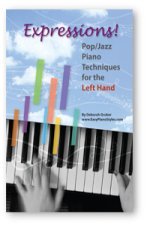
Chapter Four - Jazz Ballads. This is a really meaty chapter. You will learn how to play arpeggios, strumming, Full and Half Rolls and the Alternating Thumb technique. Great patterns for the left hand (everyone's weakness).

Chapter Five - Jazz Swing. Learn a simple version of the "Walking Bass" for the left hand that real jazzers use all the time. Then we add chord "punches" in the right hand to fill it out. All applied to "Take the "A" Train".

Chapter Six - Early Rhythm and Blues. In this chapter we explore what I call "pulsing". Then we add a little syncopated left hand to give the song some motion and rhythmic vitality.

Chapter Seven - Rock and Roll. Rock needs a hard-driving beat so we use another syncopated left hand pattern to make this happen. Called "Staccato Beat".

Chapter Eight - Folk or Children's Song. In this chapter, we break up the right hand and left hand chords in various ways. These are called "Simple Broken Chord" Techniques. Lots of cool and easy ways to break up your blocked chords. Sounds great on "Scarborough Fair".

Chapter Nine - Pop Ballad. In this Chapter, we get into more advanced ways of breaking up a chord for the right hand. Sounds awesome on "The First Time Ever I Saw Your Face"

Chapter Ten - The Blues. Learn two boogie-woogie patterns for the left hand and a right hand blues riff that will knock your socks off! You can put these patterns into any rock or R & B song.

Chapter Eleven - Latin Rhythm! Learn a Rhythm Pattern in the Right hand that will quickly add a latin flavor to your songs. It involves putting the chords of the song in a very syncopated rhythm. Once you learn this pattern, you apply it to lots of latin songs.

Chapter Twelve - Gospel. Learn the tricks of how to turn a regular old major chord into a gospel/churchy sound! You will learn the "Bass Third" and the "Amen" progression, plus a particular inversion that will change the sound of your chord.

Playing with Style - Booklet and 2 CD's $39